Parallel Operations Is the Missing Architecture in Live Event Commerce
For years, monetization inside live events has been treated either as an extension of venue existing operations or as an always-on retail problem. But live events are not static retail environments. They are compressed, high-intensity economic windows where authority, timing, and operational stability matter more than feature sets.
That is why Rivalry Commerce was built around one core principle: Parallel Operations.
Parallel Operations
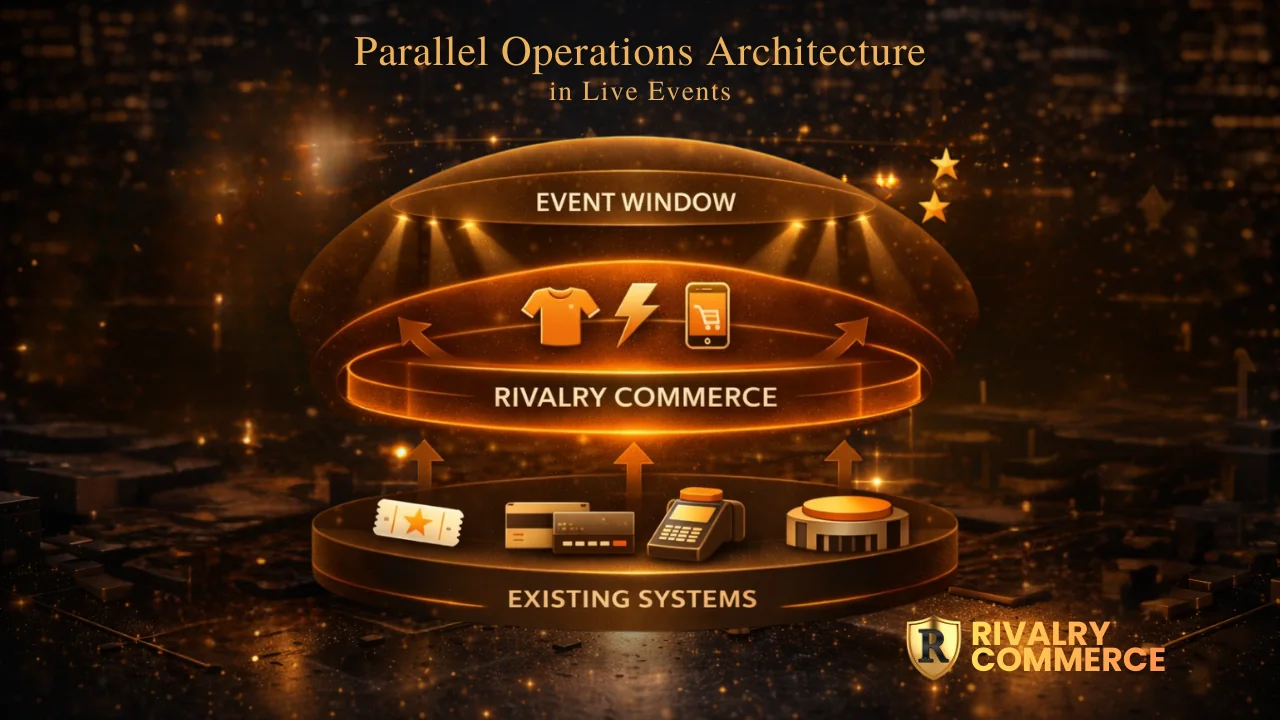
Parallel Operations means the infrastructure runs independently alongside existing operations, without replacing them. It does not attempt to rip out ticketing permanent marketplaces, payment processors, venue POS, or promoter stacks. Instead, it deploys a parallel commerce layer that activates within defined event windows.
Existing operations remain intact. Authority remains intact. Operations remain intact. The goal is not disruption; the goal is controlled expansion.
Replacement is the wrong strategy in high-compression environments because it introduces unnecessary resistance. Existing operation migration increases procurement friction, technical risk, and governance anxiety—exactly the things rights-holders avoid during active touring cycles. Parallel architecture removes that barrier because it integrates without demanding displacement.
Integration without displacement is the structural difference between expansion and disruption.
Wider Lifecycle Window
Live event commerce is often treated as something that peaks when doors open. Structurally, that's incomplete.
Fan intent begins at announcement. Momentum spikes at ticket-on-sale. Engagement builds in the days leading up to the event. If commerce only activates at physical arrival, value is artificially compressed into the narrowest window.
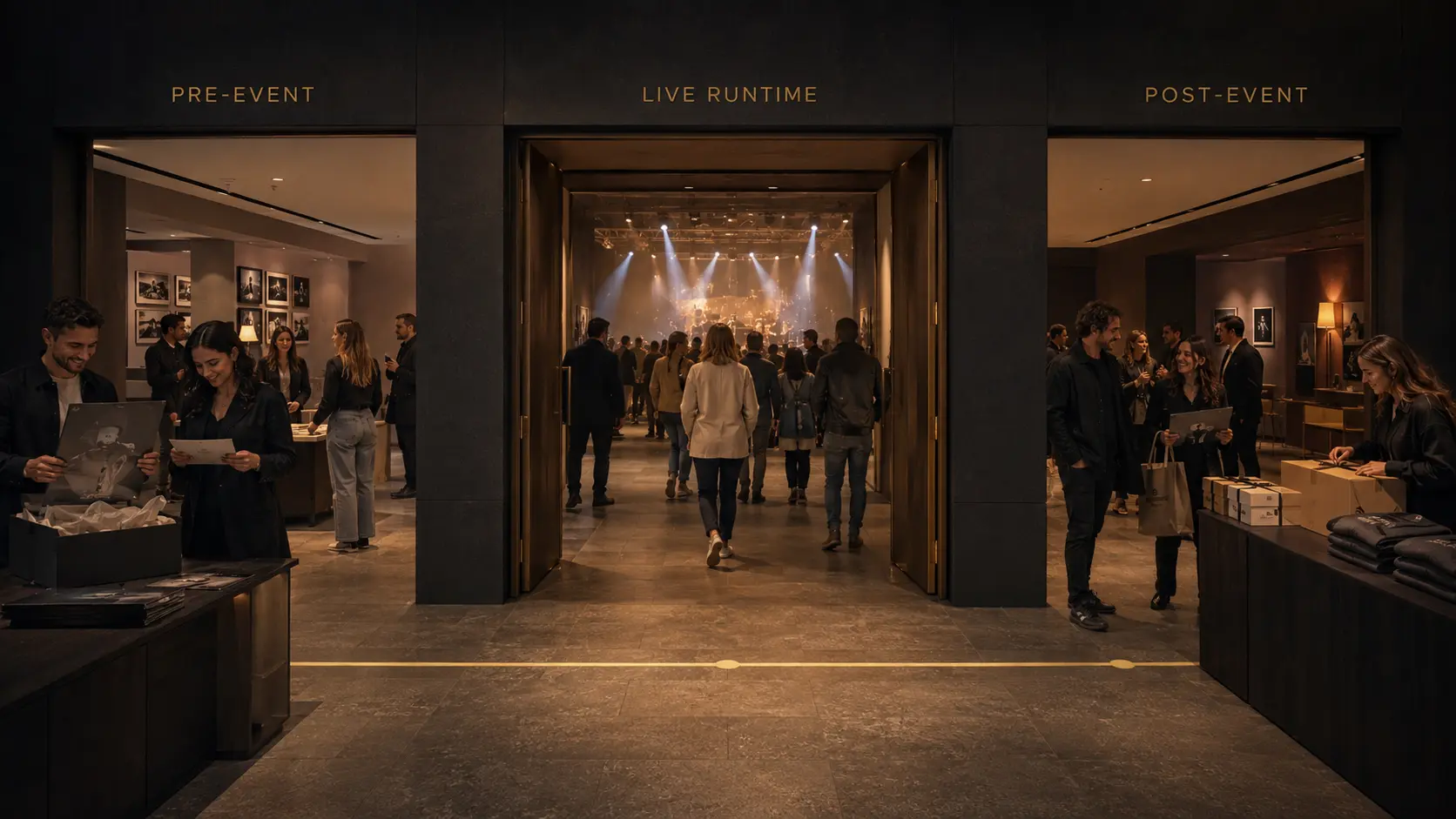
Rivalry Commerce activates at ticket-on-sale and runs through defined lifecycle windows. This expands the commercial window to match the fan journey, not just the venue timeline. It also reduces dependence on physical attendance as the sole trigger for commerce.
When infrastructure is lifecycle-aligned, pre-event engagement becomes executable as a governed commerce environment—without requiring an operational takeover.
Event-Disciplined Deployment
The deployment structure mirrors the event structure itself. Activations are event-scoped. The infrastructure is precision-deployed for a defined window and retracts when that window closes. Expansion is performance-driven, not contract-driven.
In live environments, optionality and control are not preferences—they are requirements.
Authority must be as precise as timing, so commercial control operates under time-bound licensing parameters tied directly to event windows. Scope is defined. Duration is defined. Commerce authority aligns with event authority.
When deployment matches event windows, both scale and control remain predictable.
Separate Capital & Infrastructure
Rivalry is non-custodial by design. It does not take custody of ticket revenue, merchandise revenue, or settlement capital. Funds flow through existing authorized channels. Infrastructure and capital control remain structurally separate.
This is not a minor detail. When infrastructure touches settlement, governance gets complicated. Regulatory surfaces expand. Dispute resolution becomes unclear. And rights-holders lose clarity over their own cash flow.
Rivalry provides the plumbing, not the vault. That keeps commerce authorization clean and capital control where it belongs: with the entity that earned it.
Existing Operations Stay Intact
Rights-holders retain authority over data, product, pricing, and brand presentation. This is not theoretical. It means:
Data stays yours. Parallel infrastructure does not require data handoff. Reporting is transparent. Ownership is clear. Products stay yours. Rights-holders control what sells, at what price, in what context. Brand stays yours. Commerce presentation reflects brand authority, not permanent marketplace design patterns.
Parallel infrastructure should reinforce authority, not redistribute it. When a vendor existing operation makes any of these decisions on your behalf, authority has already shifted. That is not parallel. That is displacement.
Structure Determines Leverage
Live event commerce does not need more permanent marketplaces. It does not need more feature sets. It does not need more companies taking custody of revenue or authority.
It needs architecture that respects compression, authority, timing, and institutional boundaries.
Parallel, event-scoped infrastructure is not a feature set. It's a structural decision. And structure determines leverage.
When that structure is right, expansion becomes possible without disruption. Authority remains clear. Timing aligns. And commerce activates the way events actually work—not the way retail existing operations assume they should.
The best commerce architecture is the one you barely notice. Parallel Operations is infrastructure that works because it fits the shape of the environment instead of forcing the environment to fit it.