What Is Rivalry Commerce?
Licensed Revenue Infrastructure
Live events generate attention long before the doors open and hold emotional value long after the final moment ends. Audiences plan, anticipate, travel, share, celebrate and remember. Sponsors seek meaningful visibility. Vendors want access to the people most likely to care about what they offer. Rights holders and event operators work to protect the integrity of the experience while building sustainable commercial value around it.
Yet the commercial structure surrounding most live events remains concentrated within a narrow window: the event itself.
Rivalry Commerce was founded to expand that window.
Rivalry Commerce is Licensed Revenue Infrastructure for Live Events™. It creates a rights-holder-controlled digital commerce layer that operates across the full event lifecycle—before the event, during live runtime and after the event—without replacing or disrupting the operations already in place.
It is not a ticketing company. It is not an onsite vendor. It is not a merchandise booth, concession operation or payment processor. It does not require an event operator to dismantle existing relationships, retrain staff or rebuild the infrastructure that already supports the event.
Rivalry Commerce operates in parallel.
That distinction is the foundation of the company.
Beyond Event Day
An event does not begin when a guest enters the venue.
It begins when the event is announced. It grows when tickets are purchased, plans are made and anticipation builds. It intensifies as the date approaches. During the event, attention reaches its highest level because the audience is emotionally and physically connected to the experience. Afterward, memories, conversations, photos and shared moments continue to carry value.
That entire period is the event’s commercial timeline.
Traditional event commerce typically captures only part of it. Merchandise and concessions are often limited by physical space, operating hours, staffing and the amount of inventory that can be placed onsite. Sponsor exposure is frequently tied to banners, signage or fixed placements. Vendor participation may be restricted by booth availability, location and the number of people who happen to pass by during event hours.
Those structures remain important. Rivalry Commerce does not remove them.
Instead, it creates an additional licensed digital layer around them—one capable of supporting multiple scheduled commerce moments across the life of an event.
The result is not a replacement for current revenue. It is a new opportunity to create additional revenue from attention the event has already earned.
What Rivalry Commerce Does
Rivalry Commerce establishes a governed, event-scoped commerce environment approved by the rights holder.
Within that environment, the event can support multiple digital drops, licensed merchandise moments, sponsor placements and approved vendor opportunities. Each deployment is structured around the specific event, tour, venue or licensed property. The timing, offers, products, designs and participating commercial partners remain subject to rights-holder approval.
The audience enters through an approved digital access point associated with the event. Once inside, ticket holders can encounter scheduled drops and relevant opportunities throughout the event lifecycle. Products are purchased through the appropriate approved commerce destination and fulfilled through the participating seller’s established process.
Rivalry Commerce does not take over the seller’s business. Vendors maintain control of their products, payment links, order processing and fulfillment. Rights holders maintain authority over their intellectual property, timing and commercial approvals. Existing event operations remain in place.
Rivalry Commerce orchestrates the licensed layer connecting those approved opportunities to the event timeline.
In simple terms: You approve the deployment. We orchestrate the layer.
Three Operating Windows
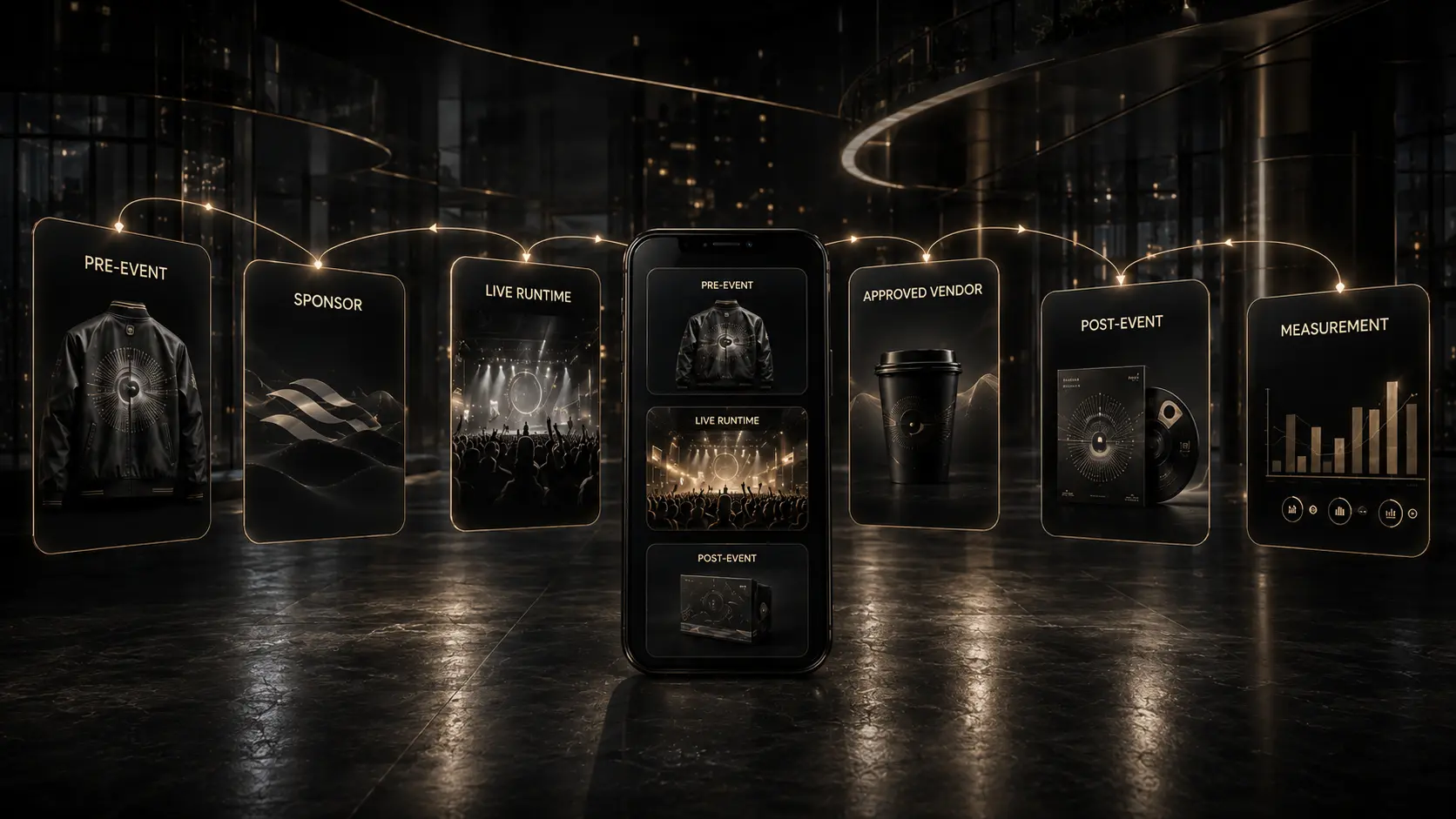
Rivalry Commerce is designed around three distinct operating windows: pre-event, live runtime and post-event. Each window serves a different purpose, and each can contain multiple scheduled drops.
Pre-Event
The pre-event window begins while anticipation is growing.
This is when the audience is planning, preparing and paying attention. Instead of waiting until the event begins, an approved deployment can introduce scheduled merchandise drops, sponsor-supported moments and vendor opportunities before attendees arrive.
Pre-event commerce can create earlier visibility for licensed products and participating partners. It can also give the audience more time to discover and consider an offer without competing against the speed and distraction of event day.
For sponsors and vendors, this window opens access to attention that would otherwise exist without a structured commerce opportunity. For rights holders, it creates additional licensed digital real estate without adding a physical footprint to the event.
Live Runtime
During live runtime, the audience’s attention and emotional connection are at their strongest.
Rivalry Commerce allows approved drops to be timed around the live experience. These moments are structured carefully so the commerce layer complements the event rather than competing with it. The purpose is not to flood attendees with constant offers. The purpose is to create a controlled cadence of relevant moments aligned with the energy of the event.
A live drop may feature licensed merchandise, an approved sponsor placement or a time-sensitive opportunity connected to a meaningful event moment. The layer operates digitally, so it does not require a Rivalry Commerce booth, onsite personnel, printed banners or changes to venue workflows.
Post-Event
The event may be over, but the audience relationship is not.
The post-event window carries the emotion of the experience forward. It can support encore merchandise, limited recovery drops, commemorative offers and continued visibility for approved partners. This allows the event to extend its commercial value beyond the physical closing time without extending onsite operations.
Post-event drops can also serve audiences who did not make a purchase during the event, could not carry merchandise with them or want something that reflects the experience after they have had time to remember it.
Together, these three windows transform one event into a governed sequence of commercial opportunities.
Parallel Operations
“Parallel” is more than positioning language. It is an operating principle.
Rivalry Commerce is built to function beside existing event infrastructure rather than inside it. Venue retail can continue. Merchandise partners can continue. Concessions can continue. Ticketing can continue. Sponsor agreements and established vendor relationships can remain in place.
The deployment does not require:
- New onsite staff
- A Rivalry Commerce booth or physical presence
- Additional event-day logistics
- Printed banners or signage
- Changes to concession workflows
- Replacement of existing merchandise operations
- Replacement of ticketing
- Deep integration with venue operations
This protects the event from unnecessary operational disruption. It also makes the commercial layer easier to define, approve and govern because its role is clear.
Rivalry Commerce is not attempting to become the event. It is infrastructure licensed to support additional value around the event.
Rights-Holder Authority
Live events are built around brands, talent, properties and intellectual property that must be protected. Any commercial expansion must respect that authority.
Rivalry Commerce is therefore structured around rights-holder control.
The rights holder determines what may appear within the deployment. That includes the timing of drops, eligible products, approved designs, participating sponsors, participating vendors and the duration of the commerce window. The deployment is not an open marketplace where outside parties gain uncontrolled access to the audience.
Access is governed.
This structure allows new revenue opportunities to be introduced without surrendering brand standards or commercial oversight. It also ensures the audience encounters a coherent experience connected to the event rather than a disconnected collection of advertisements.
The commerce layer exists under authority, not around it.
Additive Revenue
One of the most important principles behind Rivalry Commerce is that existing event revenue is not the target.
The objective is to create additional revenue opportunity layers from commercial space and timing that are not fully used today.
Those opportunities can include:
- Multiple licensed product drops across the event lifecycle
- Sponsored drop placements
- Vendor rental opportunities within approved drops
- Additional digital exposure for participating partners
- Extended post-event commerce windows
- Repeatable deployment opportunities across multiple events, cities or tour stops
Physical events have finite space. Digital commercial real estate can be scheduled, governed and repeated without adding another booth, banner or onsite sales team.
That makes the Rivalry Commerce model additive. The event’s established merchandise, sponsor, vendor and concession structures continue to operate, while the licensed layer creates more moments in which approved commerce can occur.
Approved Participant Value
Rivalry Commerce is designed to create aligned value across the event ecosystem.
Rights Holders
Rights holders gain a controlled way to extend commerce across the complete event lifecycle. They retain authority over licensing, timing, creative direction, offers and participation while opening additional revenue opportunities connected to audience attention.
Event Operators and Venues
Operators gain a digital enhancement that does not require Rivalry Commerce to be onsite. Existing workflows remain intact, and the event can expand its commercial timeline without adding physical logistics, printed materials or new staffing requirements.
Sponsors
Sponsors gain access to scheduled, event-connected visibility beyond traditional signage. Their participation can be aligned with specific drops or moments, creating an opportunity to appear within the audience’s broader event journey rather than only at the venue.
Vendors
Approved vendors gain digital exposure to a high-intent event audience. They maintain control of their products, payment destinations and fulfillment. Rivalry Commerce creates the licensed opportunity for discovery; the vendor continues operating its own business.
Ticket Holders
Ticket holders gain access to relevant, event-connected opportunities without needing to stand in another line, carry products throughout the venue or locate a physical booth. The digital layer extends the experience while allowing the audience to engage on its own device.
Measurable Performance
Commercial infrastructure should produce measurable activity.
Rivalry Commerce is structured to evaluate the performance of each deployment across the audience journey. Depending on the deployment, measurements may include audience entry, subscriber activity, notification delivery and engagement, product-drop performance, orders, sponsor impressions and vendor participation.
For recurring events and tours, performance can also be compared across dates, cities and stops. Each deployment creates an opportunity to understand what attracted attention, when audiences responded and which commercial moments performed most effectively.
The purpose of measurement is not to turn the event into a dashboard. It is to provide rights holders and operators with a clearer view of the additional activity created by the licensed layer.
That information can strengthen future scheduling, product selection, sponsor participation and deployment planning.
Events, Tours & Licensing
The infrastructure is event-scoped, which means it can be deployed for a single event, a recurring event, a multi-day environment or a tour operating across multiple cities.
For a single event, the layer follows the defined pre-event, live and post-event timeline. For a multi-day event, commerce moments can be structured across the full run. For a tour, the deployment can repeat by stop while preserving central rights-holder control and allowing performance to be evaluated from city to city.
The structure can serve concerts, festivals, fairs, sporting environments, touring properties and other licensed live experiences where audience attention extends beyond a single transaction window.
The application may change by event, but the operating principle remains consistent: create additional governed commerce opportunities without displacing the infrastructure already supporting the live environment.
Why We Were Founded
Rivalry Commerce was founded on a straightforward observation: live events create far more commercial attention than current structures are designed to capture.
The answer was not another onsite booth. It was not more signage, more staffing or a replacement for established event operations. The answer was a parallel licensed infrastructure capable of organizing commerce across the entire event lifecycle.
That required separating the opportunity from the limitations of physical space. It required recognizing that the audience relationship begins before event day and continues afterward. It required protecting rights-holder authority while creating structured access for approved sponsors and vendors. And it required building an operating model that could expand revenue without interfering with revenue already in place.
Rivalry Commerce exists to provide that structure.
It turns pre-event anticipation, live attention and post-event memory into governed commercial windows. It creates licensed digital real estate where additional opportunities can be scheduled. It gives rights holders control, operators operational separation, sponsors and vendors approved access, and ticket holders a more connected way to engage with the event.
Most importantly, it does so without asking the event to stop being what it already is.
The Next Commerce Layer
Live events will always be physical experiences. Their value, however, is no longer confined to a physical place or a few operating hours.
The audience journey is larger. The commercial timeline is longer. The opportunity can be more deliberate, more measurable and more valuable—provided it is structured under the authority of the people who own and operate the event.
Rivalry Commerce is that structure.
It is Licensed Revenue Infrastructure for Live Events™: an independent, rights-holder-controlled commerce layer operating across pre-event, live runtime and post-event windows.
It does not replace what already works.
It creates what was previously missing.
You approve the deployment. We orchestrate the layer.
About Rivalry Commerce
Rivalry Commerce provides licensed revenue infrastructure for live events. Its independent commerce layer operates across pre-event, live and post-event windows, creating additional governed opportunities for licensed drops, sponsor placements and approved vendor participation without displacing existing event operations.
To discuss a deployment, request a deployment with Rivalry Commerce.