The Economics of the Audience You Already Have

Commerce is often framed as a search for attention. But many organizations already operate around a legitimate audience built through participation, membership, attendance, enrollment, invitation, ticketing, or an established professional relationship. The overlooked question is not always how to acquire that audience. It is how authorized commercial access to it should be governed.
Businesses devote enormous resources to finding people who might care about what they sell. They invest in awareness, search visibility, paid media, sponsorship, lead generation, traffic acquisition, and the repeated work of turning unfamiliar prospects into customers.
Yet across a wide range of industries, another commercial reality has been sitting in plain sight. A dance studio already has families. A martial arts academy already has members. A preschool already has a parent community. A travel sports organization already has players, families, and supporters. A university already has a campus community. A wedding has an authorized guest list. A live event has ticket holders. A real estate professional may remain connected to clients through years of homeowner milestones.
These audiences were not assembled primarily for commerce. They emerged from a legitimate underlying relationship and a shared environment, event, activity, or lifecycle.
The audience was already there.
That observation changes the starting point. Commerce does not always have to begin with the question, How do we acquire an audience? In some environments, the more relevant question is: How should authorized commercial access to an existing audience be governed? The distinction is the foundation of Rivalry Commerce Audience-Owned™.
1. The Most Expensive Part of Commerce Is Usually the Audience
Building the basic mechanics of commerce has become increasingly accessible. Organizations can establish websites, accept payments, communicate with customers, coordinate fulfillment, and operate digital checkout with tools and services that are widely available.
Qualified attention remains much harder to create.
That does not mean customer acquisition is literally the largest expense in every company or industry. It means that finding the right people, earning a reason to be noticed, and maintaining visibility with them is often one of commerce’s most persistent and strategically significant challenges.
Awareness must be created. Search visibility must be earned or purchased. Media must be planned. Leads must be identified and developed. Traffic must be generated. Even after a business reaches a prospective customer, it may need to repeat much of that effort the next time it wants to be considered.
This continual reacquisition is partly a problem of context. A business may know that demand exists somewhere, yet still have to determine where the relevant audience can be reached, when its needs are likely to arise, and what message will be useful at that moment.
But not every organization starts from that position.
Some operate inside environments where people are already gathered for a legitimate reason. The relationship may be temporary or ongoing, formal or community-based, tied to a single event or stretched across a lifecycle. In each case, the organization may have already accomplished something businesses routinely spend substantial resources trying to achieve: it has created or organized a relevant audience around a shared context.
Some organizations have already solved that part.
2. Existing Audiences vs. Purchased Traffic
Externally acquired attention and an existing audience relationship are not simply two versions of the same asset.
Paid clicks, purchased impressions, search advertising, paid social distribution, cold outreach, and sponsored visibility can all serve legitimate commercial purposes. They can be carefully targeted, highly relevant, and valuable. The structural distinction lies in how access begins.
Externally purchased distribution creates access to an audience through a third party. An existing audience relationship begins with a direct contextual connection between an organization and the people participating in its environment.
The dance parent is already connected to the studio because a child takes classes there. The tournament family is already connected to the sports organization through participation and travel. The ticket holder is already connected to a defined live event. The homeowner is already connected to a real estate professional through an established professional relationship.
That connection should not automatically be described as trust. Trust varies, must be earned, and can never be presumed merely because a relationship exists. What the connection provides is recognition and context. The organization does not begin from anonymity.
There is already a reason for interaction. There is often clearer timing. The environment is more defined. Relevant needs may arise from the activity or lifecycle itself.
This changes the commercial problem. Instead of attempting to infer context from a broad field of attention, the organization can begin with a known environment and ask what kinds of participation, if any, naturally belong within it.
3. What Makes an Audience “Owned”
The term requires precision.
Rivalry Commerce Audience-Owned™ does not mean owning people. It does not mean controlling individuals, selling them, transferring customer lists, exploiting private information, or claiming rights over every commercial interaction in their lives.
Rivalry Commerce Audience-Owned™ describes the governance relationship surrounding a legitimate audience within a defined environment.
An Audience Owner is an organization, rights holder, business, authorized host, or similar entity that has a legitimate underlying relationship with an identifiable audience and the authority to govern participation within the event, environment, lifecycle, or commercial context it controls.
The central distinction is authorization.
An Audience Owner may decide whether commercial participation is permitted in that environment. It may determine which sponsors, vendors, services, products, or offers are appropriate. It may define the boundaries of access, the relevant moments, the duration, and the conditions under which participation occurs.
That authority is specific. A wedding couple may govern participation around an authorized guest-list experience, but not every commercial interaction involving each guest elsewhere. A rights holder may govern access around a particular event lifecycle, but not the ticket holder’s broader life. A studio may govern authorized participation inside its own community environment, but it does not own its families.
Audience ownership, in this framework, is therefore not possession. It is the legitimate authority to permit and govern participation inside a context the Audience Owner is responsible for organizing or maintaining.
4. Memberships, Guest Lists, Ticket Holders, Clients, Families, and Communities
Existing audiences appear in many forms. Some are persistent. Some recur by season. Some exist for a single event. Others develop through a long professional or personal lifecycle.
A wedding couple may have an authorized guest list connected to a defined wedding lifecycle. Relevant needs can emerge before, during, and after the wedding, with the deployment operating through an authorized event planner where required.
A dance studio may maintain an ongoing relationship with students and their families. That audience exists through participation in the studio - not because the studio bought access to those individuals through paid media.
A martial arts academy operates around members, students, parents, and families taking part in an established community. A travel sports organization operates around athletes, families, supporters, tournaments, travel schedules, and recurring seasonal moments.
A college or university may have different authorized audiences depending on the deployment: students, families, alumni, faculty, attendees, or the population associated with a defined campus event.
A real estate professional may maintain legitimate relationships with people at multiple stages: beginning a home search, preparing to sell, moving, settling in, maintaining a home, or approaching a later homeowner milestone.
A live-event rights holder may operate around ticket holders connected to a specific event or event lifecycle.
These examples differ in duration, purpose, authority, and composition. The audience connected to a wedding is not governed in the same way as a university event population or a recurring membership community. Yet the underlying principle remains consistent: different audiences, different relationships, the same need for legitimate authorization and governed commercial participation.
5. Why Existing Relationships Carry More Intent
Audience size is an incomplete measure of commercial value.
A large number of unrelated impressions may create broad awareness. A much smaller audience entering a highly relevant lifecycle moment may carry more contextual intent - not because every person will purchase, but because the circumstances create recognizable categories of need.
Families traveling for a tournament may need lodging, meals, transportation, equipment, or local services. Wedding guests may encounter relevant needs across the wedding lifecycle. New homeowners may need moving, repair, furnishings, landscaping, maintenance, or professional services. Dance families may face recurring needs connected to performances, recitals, costumes, travel, photography, and celebrations.
None of these needs guarantees a transaction. Not every family will want the same product, and not every guest will engage with an offer. Commercial relevance is not conversion certainty.
The important point is that the lifecycle itself can create predictable categories of commercial relevance. Timing, environment, and purpose can make an opportunity intelligible. A product or service does not appear simply because someone paid to place it in front of people; it appears because the Audience Owner has authorized participation and the offer belongs naturally within a defined moment.
This is contextual intent: not a promise that an audience will buy, but a defensible reason why particular needs may matter to particular people at a particular time.
6. The Difference Between Having Attention and Activating It
An audience does not automatically produce revenue. A relationship does not grant unlimited permission to promote. And Rivalry Commerce Audience-Owned™ is not an invitation to advertise more aggressively.
Activation must be authorized, relevant, governed, contextual, appropriately timed, non-intrusive, and optional for the audience.
The Audience Owner’s responsibility is not to overwhelm people with promotions or treat every interaction as inventory. It is to determine whether structured commercial participation can add legitimate value around a moment - and, if so, to establish the rules under which that participation occurs.
A sponsor may belong within a tournament experience. A local service may be useful during a move. A product may be relevant to a recital milestone. A travel offer may make sense for ticket holders preparing for an event. But relevance depends on the environment, and authorization must precede access.
Audience members retain choice. They decide whether to view, explore, or engage. Commercial participants do not receive unrestricted reach simply because they have something to sell. The Audience Owner governs who may participate and how that participation fits within the authorized environment.
Commercial access is organized around the moment rather than forced into the relationship. That is the difference between possessing attention and activating an audience responsibly. Attention is merely present. Activation requires structure, boundaries, timing, and restraint.
7. The Economic Value Hidden Inside Existing Audiences
Commerce already assigns substantial value to attention, sponsorship, qualified demand, media placement, customer acquisition, relevant visibility, and access to commercial opportunities.
Vendors routinely spend money trying to reach the kinds of people already gathered around organizations, events, memberships, communities, and important life moments. They want to be present when their products or services are useful, when timing is clear, and when the customer can understand why an offer matters.
That creates a structural question: If relevant commercial access has economic value, why is the entity responsible for creating, organizing, or maintaining the audience relationship so often missing from the economics?
The question is not an argument against paid media or external distribution channels. Those methods serve different purposes and can remain essential. Nor does the answer require selling personal information or transferring the underlying audience relationship.
The economic opportunity lies in recognizing that an Audience Owner may govern a commercial environment without surrendering the audience itself. Authorized access can be limited to a defined deployment. Participation can be selected and bounded. Timing can follow real lifecycle moments. Engagement can remain voluntary.
This reframes an existing audience from a passive communications list into a governed commercial context. The audience is not the product. The legitimate, relevant, and authorized opportunity to participate within the environment is what carries economic value.
How that value should be structured, shared, measured, and protected requires deeper examination. Those questions will continue throughout this series.
8. Introducing the Rivalry Commerce Audience-Owned™ Model
Rivalry Commerce Audience-Owned™ is a commercial framework for recognizing, governing, and activating legitimate existing audiences around relevant lifecycle moments.
The model begins with seven elements: an existing audience; a legitimate Audience Owner; authorization; a defined environment or lifecycle; governed commercial participation; relevant timing; and voluntary audience engagement.
Rivalry Commerce develops licensed commerce infrastructure designed to support authorized Rivalry Commerce Audience-Owned™ deployments.
Rivalry Commerce licenses the infrastructure used for a defined deployment. The Audience Owner authorizes that deployment and determines which sponsors, vendors, or other commercial participants may participate within the authorized environment. Rivalry Commerce does not own the audience, sell the audience, sell audience data, or require the Audience Owner to surrender the underlying relationship.
The transactional boundaries also remain clear. Vendors retain control of their own checkout, transactions, fulfillment, refunds, chargebacks, and customer relationships. Audience members choose whether to engage. The Audience Owner maintains governance over authorized commercial participation, while Rivalry Commerce operates as an independent licensed commerce layer around the defined environment.
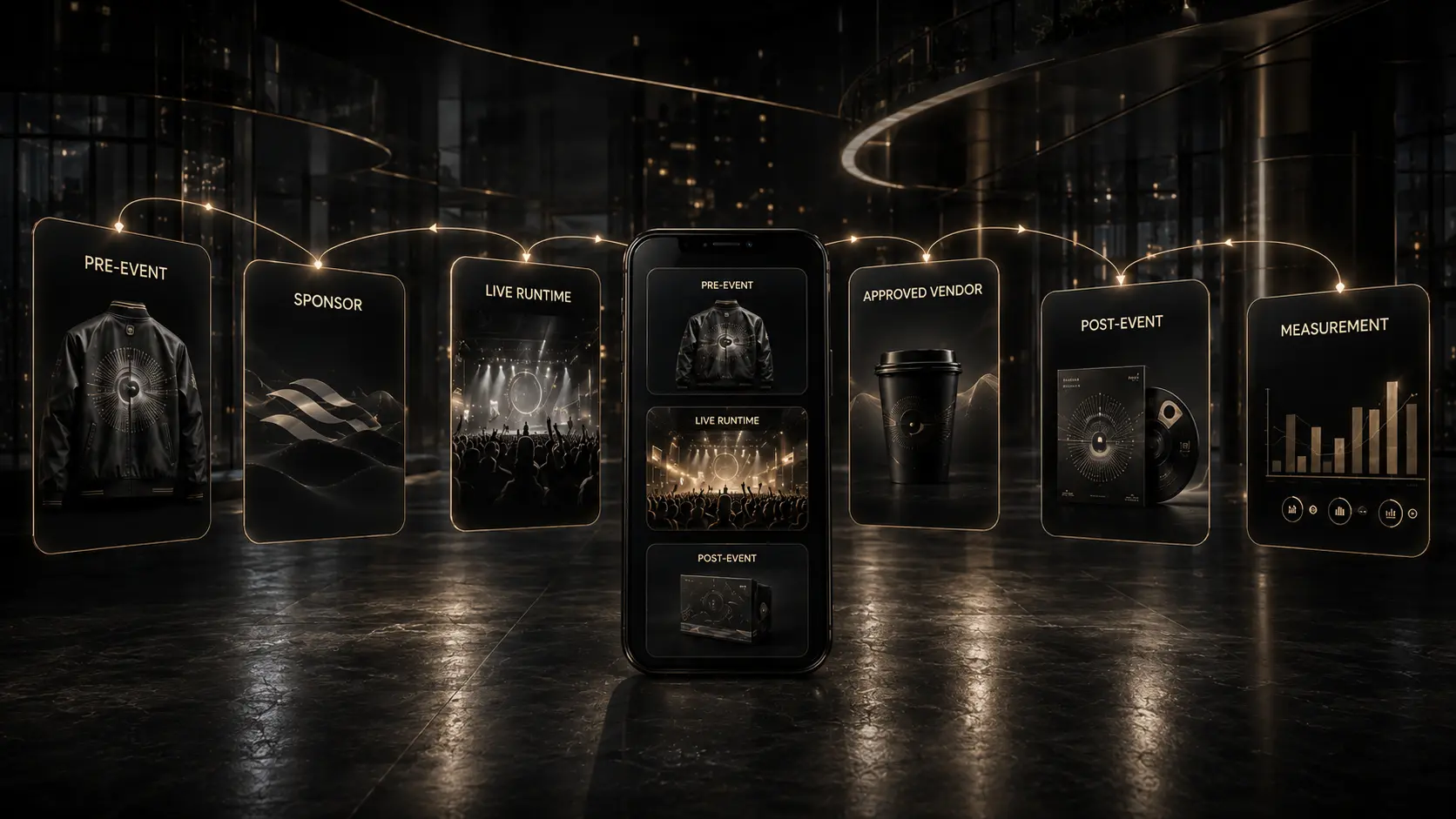
The infrastructure can support lifecycle moments before, during, and after a live event or community milestone without turning Rivalry Commerce into the merchant, retailer, event operator, rights holder, or owner of the audience.
That structure begins with a simple recognition: the most important commercial asset may not need to be acquired again. It may already exist through the organization’s legitimate work, relationships, events, and communities.
The next question is how to define it correctly.
Next in the Series
Next in the Series
Rivalry Commerce Audience-Owned™ — Part 02
You Built the Audience. Why Is Everyone Else Monetizing It?
Read Part 02 →You created the relationship. You built the trust. You brought the audience together. So why does everyone else seem to have a plan for monetizing that attention—while the person or organization that actually brought the audience together is left outside the economics surrounding it?